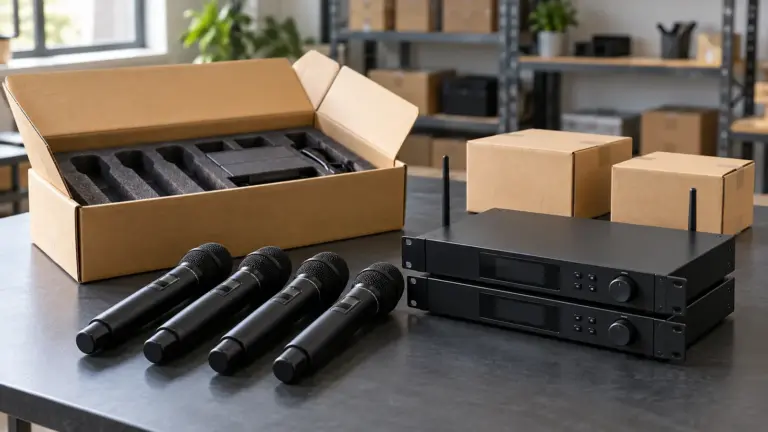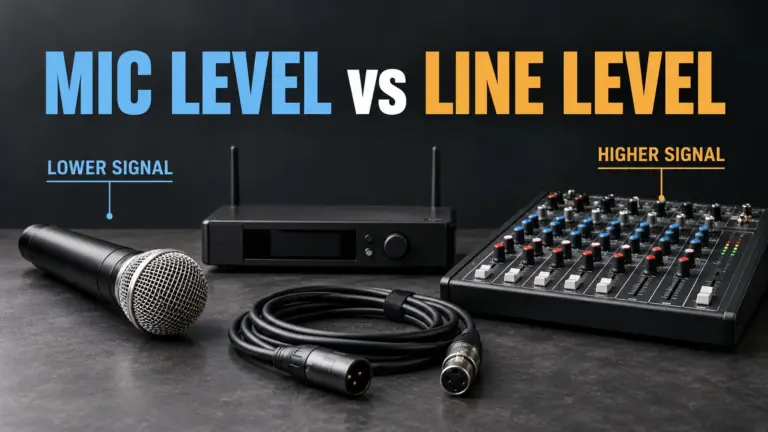


UHF is usually the more practical choice for a new commercial wireless microphone system, particularly when several microphones must work together or equipment moves between venues. Professional UHF systems commonly offer adjustable frequencies, scanning and coordinated channel groups, giving operators more ways to find usable spectrum. VHF can still make sense for a small, fixed installation—or a professionally planned system with suitable VHF spectrum.
The difference is more useful than “UHF is better.” Frequency affects wavelength and antenna size, while the system’s electronics determine how it handles audio, interference and multiple transmitters. Understanding both helps you choose equipment that fits the job.
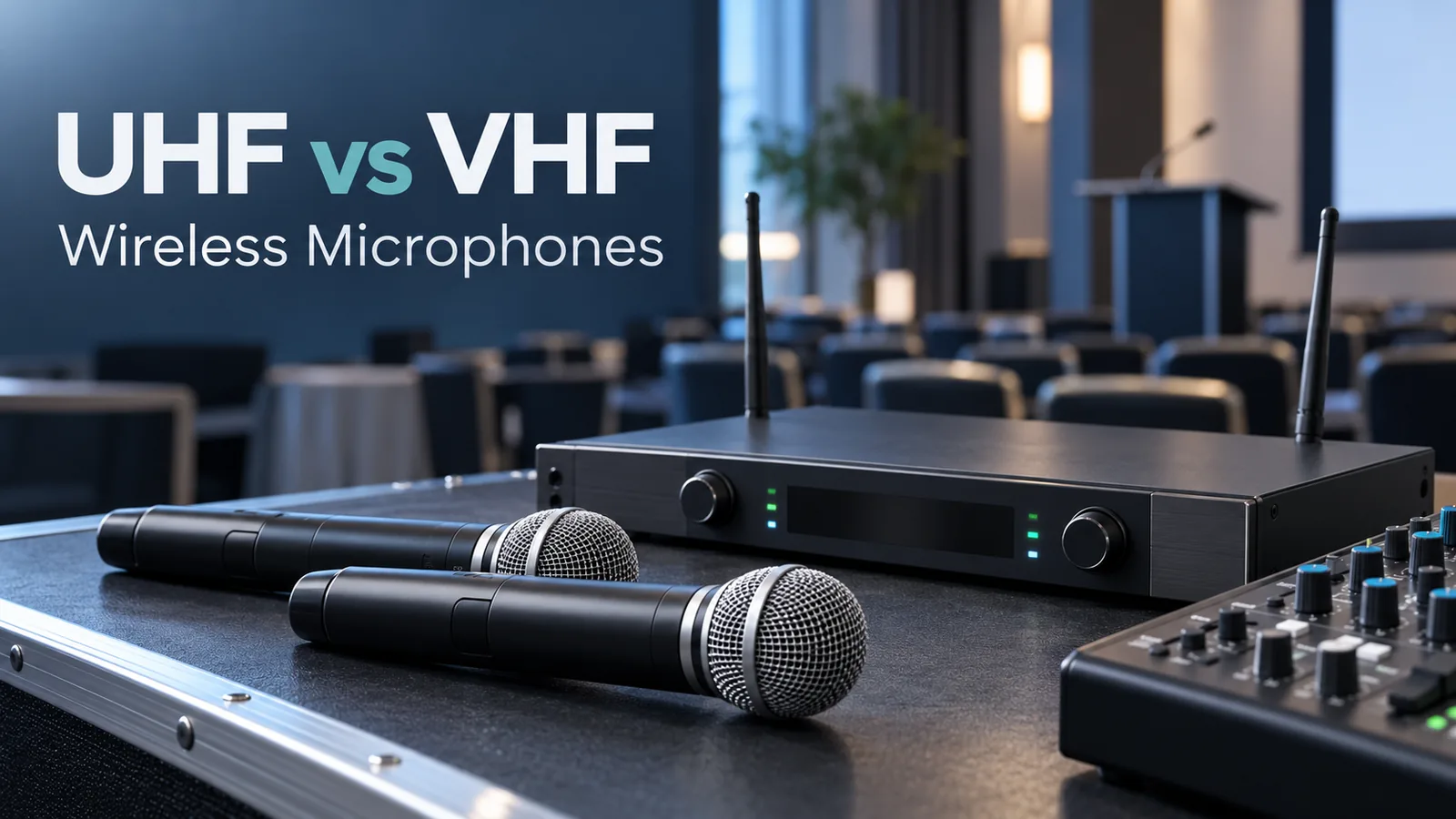
What do UHF and VHF mean?
A wireless microphone converts sound into an electrical audio signal, then uses a radio signal to carry it to the receiver. UHF and VHF describe that radio carrier, not the pitch or frequency response of the sound.
In the ITU’s radio-frequency nomenclature, VHF covers 30–300 MHz and UHF covers 300–3,000 MHz. Wireless microphones operate within specific portions of these broad ranges, according to the product and local rules. These definitions are not a list of frequencies available for microphone use.
For example, a 1 kHz audio tone remains a 1 kHz tone whether the system carries it on a VHF or UHF radio link. Moving the carrier higher does not make the voice brighter, clearer or louder.
UHF vs VHF wireless microphones at a glance
| Factor | VHF | UHF |
|---|---|---|
| Wavelength | Longer | Shorter |
| Comparable antenna design | Requires a longer antenna | Allows a shorter antenna |
| Typical entry-level offering | Often a simpler system with fewer frequency choices | Many models offer a wider choice of tuning settings; features vary |
| Expanding to multiple microphones | Check the specific system’s compatible frequencies and capacity | Professional systems commonly provide more extensive coordination and expansion tools |
| Interference | Depends on local radio activity, electrical noise and receiver design | Also depends on local activity and receiver design; UHF spectrum can be crowded |
| Operating distance | Can provide useful coverage; longer wavelength alone does not specify range | Higher frequency does not automatically mean longer range |
| Audio quality | Determined by the capsule and audio/transmission design | Determined by the same factors |
| Budget | Simple VHF systems can be economical | Cost ranges from basic systems to complex professional installations |
The product-feature differences are market tendencies, not physical rules. Shure’s selection guide explains why UHF is widely used professionally, but the actual frequency version and feature set still matter.
Five technical differences that matter in commercial use
1. Wavelength explains why VHF antennas are usually longer
Radio wavelength decreases as frequency increases. An approximate calculation is:
Wavelength in metres = 300 ÷ frequency in MHz
| Illustrative carrier frequency | Wavelength | Ideal quarter-wave antenna length |
|---|---|---|
| 200 MHz | 1.5 m | 37.5 cm |
| 600 MHz | 0.5 m | 12.5 cm |
These are calculations for explaining antenna scale, not recommended operating frequencies. Real antennas may be shortened, loaded, folded or integrated into a housing, so their visible length can differ.
The practical advantage of UHF is that efficient antennas can fit more easily into compact handheld units and receiver installations. A shorter antenna is not automatically a weaker antenna: what matters is its design for the operating frequency. This relationship follows the wavelength principles covered in Rohde & Schwarz’s RF fundamentals.
For rack installations, use antennas and distribution equipment rated for the system’s frequency range. A connector that fits does not establish RF compatibility.
2. Frequency flexibility matters more than the UHF label
A fixed-frequency system has no alternative channel when its operating frequency becomes unusable. A tunable system can move to another frequency within its supported range. A scanning function helps identify local RF activity so the operator can choose a cleaner setting.
This is one reason tunable UHF systems are useful for commercial work. A hotel may add microphones later, and a rental company may encounter different radio conditions at every venue. Having alternative frequencies gives staff a practical response to those changes.
However, tuning is a product feature. VHF can be tunable too: the Audio-Technica System 9 manual documents a VHF system with selectable frequencies. Conversely, a basic UHF model can provide fewer controls than a more capable VHF system.
Interference also involves the receiver. Other transmitters and unwanted electrical emissions can compete with the wanted signal. The receiver’s filtering and ability to handle strong nearby signals influence the outcome. A wide tuning range gives more places to look; it does not make every setting clean. Shure’s explanation of RF noise describes these external sources of interference.
3. Selectable frequencies are not simultaneous microphone channels
A receiver advertising 100 selectable frequencies is offering 100 possible settings. It is not promising that 100 microphones can operate together.
Each active link needs sufficient spectrum separation from other signals. In addition, nonlinear transmitter or receiver circuitry can produce intermodulation: unwanted signals at combinations of the original frequencies.
For an illustrative pair of carriers at 600 and 601 MHz, two possible third-order products are:
- 2 × 600 − 601 = 599 MHz
- 2 × 601 − 600 = 602 MHz
A third microphone placed on one of those frequencies could encounter interference even though its setting differs from the first two. These numbers illustrate the mechanism, not a usable channel plan. Shure’s intermodulation guide explains where these products originate.
This is why commercial systems use compatible frequency groups or coordination software instead of simply assigning consecutive settings. Receiver selectivity, signal bandwidth and available local spectrum also affect the achievable count.
Count microphones across nearby rooms as well. Six meeting rooms with two microphones each may require a plan covering all 12 links. Shure’s frequency-selection guidance explains this facility-wide consideration. Professional UHF platforms are often convenient for expansion because of their coordination tools, but capacity remains specific to the system and location.
4. Longer range comes from the complete radio link
Neither band has a universal commercial operating distance. Reception depends on transmitted signal strength, antenna efficiency and placement, cable losses, receiver sensitivity, obstacles and the interference level at the receiver.
Frequency changes how a wave interacts with its surroundings, but “higher frequency travels farther” is not a valid selection rule. Nor should “UHF penetrates walls better” be assumed for every building. Wall materials, openings and the actual signal path matter.
Indoor dropouts often involve multipath fading. A receiver picks up both the direct signal and reflected copies. At some positions, those copies arrive out of phase and partially cancel. Moving the microphone can therefore produce a weak spot even when the receiver is nearby.
Diversity reception uses different reception paths to reduce the chance that the same fade interrupts the audio. Antenna position remains important, as explained in Shure’s antenna-placement guidance. Our true diversity wireless microphone guide covers receiver architecture in more detail.
For a ballroom or presentation room, a useful test is to walk the actual speaking routes with the antennas in their planned positions and normal venue equipment running. Include turning away from the receiver and moving through audience areas. That reveals more than a maximum-distance demonstration in an empty outdoor space.
5. Sound quality depends on the audio design, not carrier frequency
The microphone capsule and its placement shape the captured sound. Input gain determines how much headroom remains before loud speech or singing overloads the transmitter. The wireless audio design then determines how that signal is transmitted and recovered.
Many analogue FM systems use companding: the transmitter compresses the audio’s dynamic range and the receiver expands it again. The quality of this processing can affect noise and audible changes in level. Digital systems generally avoid analogue companding, but conversion and processing introduce latency. Shure’s digital wireless overview explains these differences.
UHF/VHF and analogue/digital are separate choices. Professional digital VHF systems have also been developed, as documented in Shure’s VHF system announcement.
When comparing samples, match listening levels and use the same sound system. Listen to quiet speech, normal presentation and loud vocals. Check background noise, clarity and overload behaviour. A louder demonstration can sound more impressive without representing better audio quality.
Which should you choose for your commercial application?
For a new installation, the strongest reason to choose UHF is usually operational flexibility: finding compatible channels, changing frequencies when necessary and supporting more equipment over time. The following choices apply that principle to common projects.
| Application | Practical starting point | Reason |
|---|---|---|
| One small training room with a few microphones | Compare a suitable VHF system with an entry-level tunable UHF system | A stable, modest setup may not need extensive coordination features; usable frequencies and clear audio matter most |
| Hotel, school or conference centre with nearby rooms | A coordinated, expandable UHF platform | Planning the whole facility helps prevent room-by-room purchases from conflicting |
| Multi-room karaoke venue | Tunable UHF with a documented compatible channel plan | Several rooms can create a substantial combined microphone count; assess loud-vocal handling separately |
| Rental equipment or changing live-event sites | Professional tunable UHF with scanning and coordination support | Staff need ways to adapt to different local spectrum and existing event equipment |
| Existing VHF installation that works reliably | Review its capacity and support before replacing it | Replacement is worthwhile when requirements change, not simply because the label says VHF |
A professional VHF option may also be useful where UHF spectrum is congested and suitable VHF frequencies are available. That requires a compatible system and a site-specific plan; switching bands by itself does not solve coordination.
For buyers comparing another common option, our 2.4GHz wireless microphone guide explains its setup benefits and shared-spectrum limitations.
What to confirm before buying from a supplier
Once the band and system type are shortlisted, confirm five items:
- Exact frequency version: obtain the model suffix and operating frequencies, not just “UHF” or “VHF.” Check permitted use in each destination country. The Ofcom PMSE guidance is one example of country-specific licensing information.
- Simultaneous capacity: ask for a compatible plan covering all microphones that will run together, including nearby rooms and existing equipment.
- Receiver and antenna arrangement: confirm diversity architecture, antenna placement and any distribution hardware required.
- Complete supplied configuration: check handheld microphones or bodypacks, receiver channels, output connections, power supplies and accessories.
- Sample performance: verify audio, coverage and simultaneous operation in a representative setup before committing to a bulk order.
For a wider view of supplier selection and order preparation, see our Enping professional audio sourcing guide.
Frequently asked questions
Can a VHF microphone work with a UHF receiver?
A VHF-only transmitter cannot work with a UHF-only receiver. They must share a supported operating frequency and compatible transmission format. Even two UHF devices using the same frequency may be incompatible if their modulation, coding or control requirements differ.
Is 2.4GHz the same as UHF?
Under the broad radio definition, 2.4GHz falls within UHF. In microphone product comparisons, however, “UHF” usually refers to lower-frequency systems such as those using parts of the TV spectrum, while 2.4GHz products are discussed separately because their radio environment and system designs differ.
Is a more expensive UHF microphone always worth buying?
Only if the additional capability serves the installation. Useful differences may include better receiver performance, frequency coordination, supported channel count, serviceable batteries or installation accessories. Paying for unused features will not improve a simple system automatically.
Choosing with EP AudioSource
For new commercial projects with multiple microphones or changing venues, prioritize a well-designed tunable UHF system. For a small fixed installation, a suitable VHF system can still provide what the job requires. In either case, the decisive evidence is the exact frequency version, compatible channel plan and performance of the complete system.
EP AudioSource is an independent B2B audio sourcing and coordination service based in Enping, China. We help buyers clarify requirements, identify suitable manufacturers, and coordinate quotations, samples and OEM/ODM communication. Product availability and commercial terms are confirmed with the selected supplier.
Contact EP AudioSource about your wireless microphone requirements with your destination country, venue type, simultaneous microphone count and estimated order quantity.