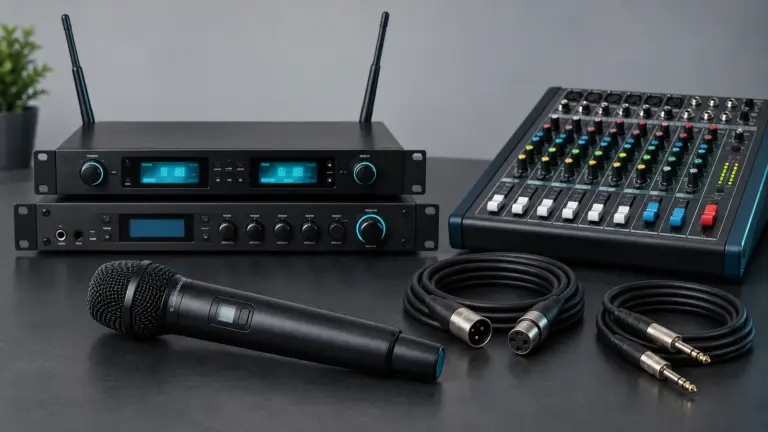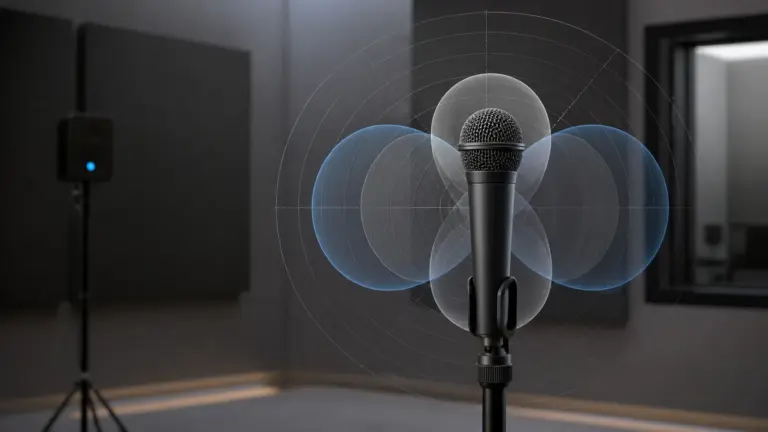


A true diversity wireless microphone system uses two antennas and two independent receiver sections for each audio channel. Both receiver paths monitor the same microphone transmission. The system then selects or combines the cleaner audio path, reducing the chance that one weak or cancelled RF path will interrupt the sound.
That distinction matters. A receiver can have two visible antennas without being a true diversity design. For importers, distributors, audio brands, system integrators, and rental companies, “true diversity” should therefore be treated as an architecture to verify—not just a phrase printed on a product page.
This guide explains what true diversity does, what it cannot fix, and what Southeast Asian B2B buyers should check before sourcing a wireless microphone system from China.
Why Do Wireless Microphones Experience Signal Dropouts?
A wireless microphone sends audio by radio frequency from a handheld or bodypack transmitter to a receiver. The signal may travel directly to the receiver antennas, but it can also reflect from walls, ceilings, floors, metal structures, LED screens, equipment racks, and people.
These reflected copies arrive by different paths. At a particular antenna position, they can partially or deeply cancel one another. This effect is commonly described as multipath fading. A presenter or performer may move only a short distance and suddenly enter a weak RF spot, even when the nominal operating range has not been exceeded.
Wireless dropouts can also have other causes, including:
- RF interference from another transmitter or electronic source;
- poorly coordinated frequencies in a multi-channel system;
- antennas hidden inside a metal rack or placed away from the operating area;
- damaged or unsuitable antenna cables;
- an obstructed signal path between the transmitter and receiver;
- incorrect transmitter gain, squelch, or system setup;
- low battery voltage or a faulty component.
Shure’s wireless troubleshooting guidance similarly identifies antenna problems, interference, frequency conflicts, cables, and system components as possible causes. True diversity is valuable, but it is only one part of a reliable RF system.
How Does a True Diversity Receiver Work?
The basic process has four parts.
1. Two antennas receive the same transmission
The antennas occupy different positions or orientations. Because the two RF paths are not identical, a deep fade at antenna A is less likely to occur at exactly the same time and strength at antenna B.
2. Each antenna feeds an independent receiver section
This is the defining point. A true diversity receiver has two dedicated receiving paths—not one receiver section that merely switches between two antenna inputs.
3. The system evaluates both paths
The receiver monitors signal or audio quality from the two sections. Depending on the design, it can switch to the better demodulated audio path or combine the two paths.
4. The better audio reaches the output
If one antenna enters a multipath null, the other path may remain usable. The receiver can therefore maintain the audio output instead of allowing the weak path to produce a dropout.
Shure describes true diversity as a design using two antennas, two dedicated receiver sections, and an audio switching or combining stage. This is why true diversity can offer more robust reception than a basic single-receiver antenna-switching design.
True Diversity vs. Diversity vs. Two Antennas
The terms used in supplier listings are not always consistent. Buyers should compare the actual signal architecture.
| Receiver description | Typical architecture | Buyer implication |
|---|---|---|
| Non-diversity | One antenna and one receiver path | Most exposed to position-dependent fades |
| Antenna-switching or predictive diversity | Two antenna inputs, usually one receiver section | Can improve reception, but is not the same architecture as true diversity |
| True diversity | Two antennas and two independent receiver sections | Both paths are available for comparison at the receiver/audio stage |
| Audio-combining diversity | Two receiver paths with a combining method | Can blend or weight the available paths rather than making only a hard switch |
The front panel does not prove the internal design. Two antennas may serve two separate audio channels, or they may feed a single switching receiver. When the distinction affects your product positioning or project reliability, request a block diagram, circuit-level explanation, user manual, or sample demonstration from the responsible manufacturer.
How Does True Diversity Help Prevent Dropouts?
True diversity mainly reduces dropouts caused by a weak or cancelled path at one antenna. It is particularly useful when the transmitter moves or when the operating area contains reflective surfaces and changing obstructions.
Typical applications include:
- live stages and karaoke venues;
- conference and training rooms;
- houses of worship;
- schools and auditoriums;
- hotels and event spaces;
- rental systems that must work in different venues;
- corporate presentations where even a short interruption is unacceptable.
The improvement is statistical rather than absolute. The two paths give the receiver another opportunity to recover usable audio. They do not make the radio environment perfect.
What True Diversity Cannot Solve by Itself
It cannot guarantee zero dropouts
If both antenna paths are weak, blocked, incorrectly connected, or affected at the same time, the audio may still drop out.
It cannot remove strong RF interference
A different transmitter operating on the same or a nearby incompatible frequency can disturb both receiving paths. Frequency scanning and coordination remain essential, especially when multiple wireless microphones are used together.
It cannot compensate for poor antenna installation
Two receiver sections are not useful if an antenna is missing, damaged, placed inside a metal rack, or connected through an unsuitable cable. The antennas still need a clear relationship with the operating area.
It does not prove audio quality
True diversity describes reception architecture. It does not by itself confirm capsule quality, frequency response, dynamic range, latency, companding performance, build quality, battery life, or manufacturing consistency.
It does not confirm local regulatory suitability
Wireless microphone frequency rules differ by destination market and can change. A model suitable for one country should not automatically be assumed suitable for Indonesia, Malaysia, the Philippines, Singapore, Thailand, Vietnam, or another market. Buyers should confirm the intended country, legal tuning range, channel plan, labeling, and required conformity documents before ordering.
When Should a B2B Buyer Specify True Diversity?
True diversity is worth considering when a dropout would disrupt the event, damage the buyer’s brand, or create repeated service calls. It becomes more relevant when:
- presenters or performers move through the operating area;
- the system will be used in reflective or crowded venues;
- several wireless channels must operate at the same time;
- the buyer supplies rental, installation, education, worship, hospitality, or event markets;
- the product will be positioned above entry-level antenna-switching systems;
- the system must be deployed in different buildings with limited setup time.
For a low-cost, fixed-position application in a small, controlled room, a simpler diversity architecture may meet the requirement. The right choice depends on the expected failure cost, target retail position, RF environment, and total system design—not on one feature alone.
What Southeast Asian Buyers Should Confirm Before Sourcing
1. Destination country and tuning range
Tell the supplier every country in which the product will be sold or installed. Request the exact tuning range and channel spacing rather than accepting “UHF” as a complete specification. If one order serves several countries, confirm whether separate frequency versions are required.
2. Number of simultaneous systems
“Many selectable frequencies” is not the same as “many compatible channels.” Ask how many systems can operate together under a coordinated frequency plan and under what test conditions.
3. Receiver architecture per audio channel
For a dual-channel receiver, confirm whether each audio channel has two independent receiver sections. Four antennas on a chassis do not automatically prove that both channels are true diversity.
4. Intended application and operating environment
Specify whether the system is for karaoke, conferences, worship, education, rental, live performance, or another use. Include the expected operating distance, line-of-sight conditions, rack location, audience size, and whether the transmitter will remain fixed or move around the venue.
5. Complete system configuration
Confirm the transmitter type, capsule or headset option, receiver outputs, power supply and plug, antenna connectors, rack accessories, battery format, charging method, packaging, manuals, and spare parts.
6. OEM and compliance requirements
Send logo files, color references, packaging languages, barcode requirements, target certification documents, and inspection criteria early. The responsible manufacturer must evaluate what is available for the selected model and order quantity.
How to Verify a Sample Before a Bulk Order
A useful sample review should go beyond turning the microphone on in a quiet office.
Confirm the architecture
Ask for a receiver block diagram or a written explanation showing two independent receiving sections for each true diversity channel. Compare the explanation with the user manual and the receiver indicators.
Run a controlled walk test
Set up the receiver where it would normally be installed. Walk the full operating area while speaking continuously. Include stage edges, aisles, doors, equipment racks, and areas where people or structures may obstruct the path.
Observe both antenna paths
If the receiver displays A/B activity or RF levels, record what happens while the transmitter moves. A true diversity system should be able to use the alternate path when one path becomes weaker, although the exact display behaviour varies by design.
Test the planned channel count
If the project needs eight simultaneous microphones, testing one system is insufficient. Ask for a coordinated frequency plan and evaluate the intended number of active transmitters together.
Reproduce a realistic RF environment
Whenever practical, test at the intended venue or in an environment containing the other wireless systems likely to be present. Document receiver location, antenna position, frequencies, distance, obstructions, batteries, and test duration so different samples can be compared fairly.
Record other purchasing criteria
Evaluate audio output, noise, handling noise, battery runtime, connectors, controls, display readability, enclosure quality, accessory fit, packaging, labeling, and consistency between sample units. True diversity should not distract from the rest of the product specification.
RFQ Checklist for a True Diversity Wireless Microphone
Include the following information when contacting a supplier or sourcing representative:
| RFQ item | Information to provide |
|---|---|
| Destination market | Country or countries of sale and use |
| Buyer type | Importer, distributor, brand, integrator, rental company, or project buyer |
| Application | Karaoke, conference, stage, worship, education, hospitality, rental, etc. |
| Configuration | Handheld, bodypack, lavalier, headset, single-channel, dual-channel, or multi-channel |
| Required architecture | Two independent receiver sections per true diversity audio channel |
| Channel count | Number of systems required simultaneously |
| Operating conditions | Distance, movement, obstacles, rack position, indoor/outdoor use |
| Frequency requirements | Legal tuning range and coordination needs for the destination market |
| OEM requirements | Logo, color, housing, display, packaging, manuals, accessories |
| Compliance documents | Documents required for import and sale in the target market |
| Commercial information | Estimated order quantity, sample needs, target schedule, and delivery destination |
A detailed brief allows the responsible manufacturer to determine whether an existing platform fits the project or whether configuration, testing, or development work is required.
Frequently Asked Questions
Does true diversity completely eliminate wireless microphone dropouts?
No. It reduces the risk of dropouts caused by one weak or cancelled antenna path. Interference, poor frequency coordination, blocked antennas, damaged cables, low batteries, or faults can still interrupt the system.
Are two antennas enough to prove that a receiver is true diversity?
No. True diversity requires two independent receiver sections for the audio channel. Two visible antennas may be used by a single switching receiver or by separate channels.
Is true diversity the same as frequency diversity?
No. True diversity normally refers to two receiving paths for the same transmission. Frequency diversity uses more than one frequency path and requires a different system architecture.
Does a true diversity receiver prevent interference from other wireless microphones?
Not by itself. The systems still need compatible frequencies, suitable antenna placement, and proper RF coordination.
What information should I send when requesting a quotation?
Provide the destination country, application, estimated quantity, required simultaneous channel count, operating distance, transmitter configuration, tuning-range requirement, OEM details, compliance-document needs, and sample-testing plan.
Source a Wireless Microphone System with Clearer Requirements
True diversity can be an important reliability feature, but only when the receiver architecture, frequency plan, antenna setup, and complete product specification match the intended market.
EP AudioSource helps overseas buyers clarify requirements and communicate with suitable audio equipment manufacturers in Enping. EP AudioSource is a sourcing and coordination contact rather than a single finished-product manufacturer. The selected manufacturer remains responsible for its quotation, contract, production, quality, and delivery terms.
To evaluate a project, send your wireless microphone sourcing brief with the destination market, application, channel count, estimated quantity, frequency requirements, and OEM needs. Qualified business buyers may also request a product sample for evaluation, subject to manufacturer review, availability, and confirmed sample terms.