

Buying directly from an Enping audio factory can suit buyers who already have a suitable supplier, clear specifications and the resources to manage samples, production questions and inspections. A sourcing service can help when you need manufacturer matching, quotation coordination or local follow-up.
These approaches can work together. With EP AudioSource, buyers establish the commercial relationship with the selected manufacturer while EP assists with sourcing and communication. The decision is how much coordination your team needs, alongside the direct factory relationship.
Direct Factory Buying vs. a Sourcing Service: At a Glance
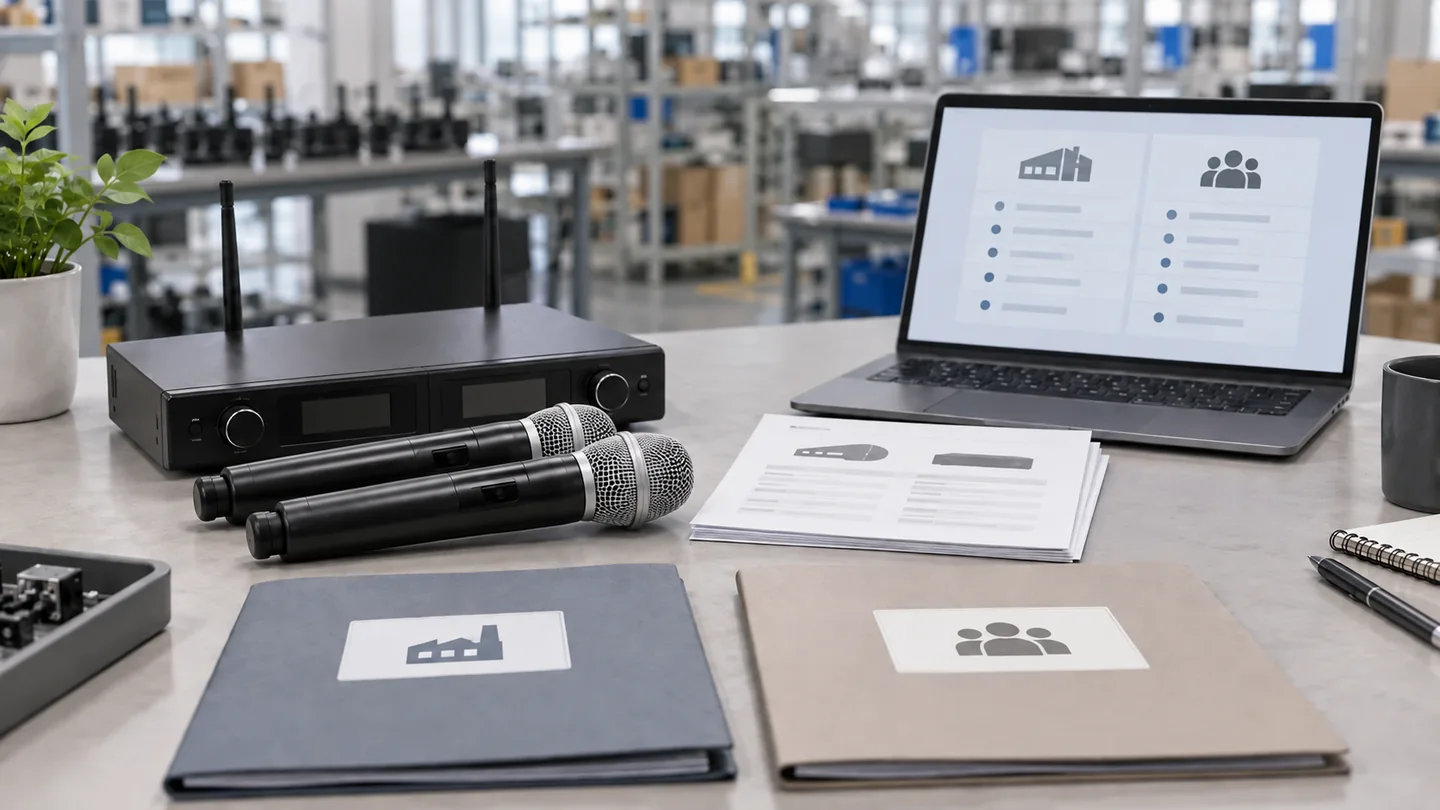
For this comparison, “buying direct” means managing the factory relationship yourself. “Using a sourcing service” means adding agreed sourcing or coordination support. Providers differ, so confirm the actual scope before proceeding.
| Decision area | Managing the factory yourself | Adding a sourcing service |
|---|---|---|
| Supplier discovery | Your team finds and shortlists suitable manufacturers. | The service may help identify options against your brief. |
| Specifications and quotations | Your team resolves questions and makes quotations comparable. | A coordinator can collect responses and track unresolved details. |
| Samples and revisions | Your team records versions, feedback and approvals. | The service may coordinate samples and communicate changes. |
| Local follow-up | Your team contacts the factory or arranges local support. | A local contact may assist with appointments and progress updates. |
| Costs | Assess the quotation and the work your team must perform. | Confirm fees, any supplier relationships and what support is included. |
| Quality and inspection | Define acceptance criteria and arrange the checks you need. | Confirm whether inspection is included, separate or outside the scope. |
| Contract and payment | Confirm the actual seller and payment recipient. | Confirm them again; a coordinator does not automatically become the seller. |
No route removes the need to approve specifications and commercial terms. For the wider process, see our guide to sourcing professional audio equipment from Enping.
When Buying Direct from an Enping Audio Factory Makes Sense
Direct management is a practical choice when the supplier and product are already well understood. Your team should be able to explain the application, review technical answers, approve samples and follow up on an agreed schedule.
It is especially worth considering when:
- You have evaluated the manufacturer and tested the relevant product version.
- The order is a repeat of a documented configuration.
- Your purchasing and technical staff can resolve questions with the factory.
- You can arrange inspections or specialist checks when needed.
- You have a clear process for handling changes, defects and after-sales requests.
For example, consider a distributor reordering an approved wireless microphone system with unchanged branding, accessories and packaging. If communication is working and the factory confirms the production version, the buyer may have little need for additional coordination.
Direct access can also be useful during engineering discussions. Ask who can answer questions about the actual product, and record decisions in the approved specification. A discussion with a sales contact alone should not be treated as confirmation of every requested modification.
When Local Sourcing Coordination Is Useful
Local coordination becomes more useful when the work extends beyond asking one known supplier for a price. You may need to identify manufacturers, compare different product versions or keep several sample discussions aligned.
Consider support when:
- You are approaching Enping manufacturers for the first time.
- Similar-looking products have different configurations or accessories.
- Quotations leave important technical or commercial questions unanswered.
- Your team needs help communicating OEM or packaging revisions.
- You want to coordinate a factory visit or follow up on sample readiness.
- A project involves several manufacturers and separate timelines.
An illustrative project might combine wireless microphones, a compact mixer and a conference system. A coordinator can help track each supplier's responses, while the buyer or its technical adviser still checks whether the selected products work together.
Start with a defined assignment: identify possible manufacturers, obtain comparable quotations, coordinate samples, or follow up on agreed milestones. Ask what evidence or written update you will receive for each task.
Manufacturer profiles can support initial discovery. Use them to prepare questions, then confirm the information relevant to your own order.
What Audio Buyers Should Check with Either Route
Audio procurement requires more detail than a product photograph and a unit price. Use the same written brief whether you contact factories yourself or work through a coordinator.
Wireless Microphone Requirements
For a wireless microphone sourcing project, ask suppliers to identify:
- The exact receiver and microphone configuration.
- The proposed tuning range for the destination country.
- The number of microphones required to operate simultaneously.
- The conditions supporting any simultaneous-use or operating-distance claim.
- The receiver outputs and their compatibility with your mixer or other equipment.
- The power supply, batteries, accessories and documents included in the quotation.
Selectable frequency settings are not the same as the number of microphones that can operate together. Compatible frequency planning also depends on the equipment and local RF environment. Shure's wireless frequency guidance explains why model-specific compatibility information matters.
State the destination country at the start, and confirm applicable frequency and product requirements with the relevant local authority or qualified adviser. Do not treat a supplier's available frequency version as confirmation that it suits every market.
OEM Changes and Approved Samples
Describe each customization separately: logo placement, packaging, manual language, accessories, appearance or functional changes. Ask the manufacturer to confirm feasibility, minimum quantities, additional costs and the approval sequence for each item.
Record which sample was evaluated, its configuration and the changes still outstanding. If a later revision changes the product, decide which checks must be repeated before approving production.
A sourcing coordinator can communicate these requirements and track responses. Technical acceptance should remain tied to documented evidence and the buyer's agreed criteria.
Compare the Full Cost and Clarify Responsibilities
A useful comparison starts with equivalent quotations. Align the product version, quantity, accessories, packaging, sample requirements and delivery destination before comparing totals.
Then account for the costs and work relevant to your project:
- Product and customization charges.
- Samples, tooling and courier charges.
- Testing or inspection services you require.
- Freight and destination charges relevant to the agreed delivery terms.
- Any separately agreed sourcing or coordination charges.
- The staff time needed to resolve questions and manage changes.
There is no reliable universal saving percentage for either route. A lower product price can come with a different configuration or excluded services; additional coordination only helps if it addresses work your project actually needs.
Ask any sourcing provider how it is compensated, whether it has commercial relationships with proposed suppliers, and whether you can communicate directly with the manufacturer. Use the answers to understand its role and incentives.
Also clarify who will:
- Issue the quotation and sign the sales contract.
- Receive the order payment.
- Approve samples and production changes.
- Perform and document any inspection.
- Handle product defects, warranty requests and shipment arrangements.
Put the agreed responsibilities in writing. Progress updates and factory visits can support communication, but they do not by themselves establish that goods meet your acceptance criteria.
How EP AudioSource Works with Buyers and Manufacturers
EP AudioSource is an independently operated B2B audio sourcing and communication service based in Enping, Guangdong, China. Depending on the project, it may assist with manufacturer matching, quotations, samples, OEM/ODM communication and production follow-up.
Buyers contract with and pay the selected manufacturer directly. The manufacturer remains responsible for producing and delivering the goods under the agreed contract. EP supports the communication process and is not an independent testing laboratory, certification body or payment guarantor.
According to the current EP AudioSource FAQ, standard manufacturer-matching and order-follow-up services carry no buyer sourcing fee, introduction fee or commission. Product, sample, tooling, packaging and other agreed order-related costs remain payable as applicable. Confirm the scope and any additional arrangements before proceeding.
This structure lets a buyer retain a direct manufacturer relationship while receiving local coordination support. It suits projects where help with communication and follow-up is useful, provided that the buyer separately addresses any technical assessment or independent inspection it requires.
Questions to Ask Before Choosing Your Sourcing Route
Use these questions to decide what support you need:
- Have we identified a suitable manufacturer? If not, supplier discovery may be the first assignment.
- Can we compare the quotations on the same specification? If not, resolve the missing information before selecting on price.
- Who will manage sample feedback and revisions? Assign an owner and keep a written version record.
- Who will assess the technical evidence and inspect the goods? Name the responsible team or provider.
- Do we understand the service's scope and compensation? Ask for clarification rather than assuming all sourcing services work alike.
- Are the contracting company, payment recipient and after-sales contact clear? Resolve unanswered questions before placing the order.
If your team can already handle these tasks, direct factory management may be sufficient. If discovery and coordination are the main gaps, a defined local service may help. Where the gap is specialist testing or independent inspection, arrange that expertise explicitly.
Prepare Your Audio Sourcing Brief
To discuss manufacturer matching or coordination with EP AudioSource, prepare:
- Destination country and intended application.
- Product category and required configuration.
- Estimated sample and order quantities.
- Required simultaneous microphone count, where relevant.
- OEM/ODM, branding and packaging requirements.
- Target schedule, sample checks and documentation needs.
- Any existing quotation or specification you want to clarify.
Send your audio sourcing brief to EP AudioSource to discuss suitable manufacturing options and the coordination your project requires.