

To get a lower minimum order quantity (MOQ) for audio equipment, start with smaller manufacturers that already make the product you need. Ask for their standard configuration and packaging, then identify which changes would increase the minimum. Some Enping manufacturers accept small orders on an EXW-only basis, with factory-arranged transport limited to an agreed address in China. For these orders, you need a freight forwarder to arrange the onward shipment.
This guide focuses on overseas distributors, importers and audio brands planning a first order from Enping. Smaller manufacturers can offer more flexible quantities than larger factories, but the workable minimum depends on the model, customization and delivery arrangement. Compare those conditions together before committing your budget.
Why smaller manufacturers may accept a lower MOQ
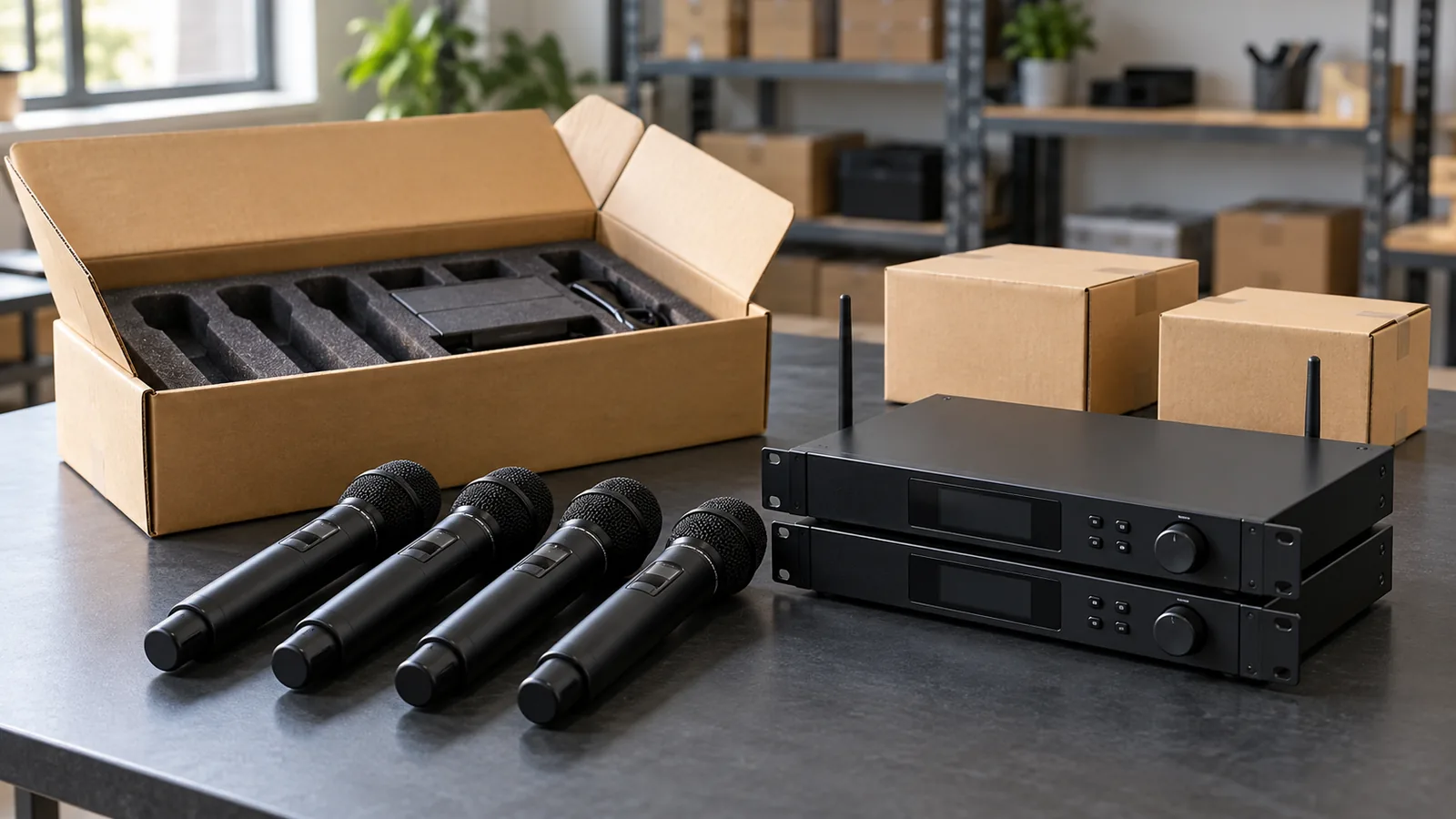
A large factory’s preferred order size may not match a distributor testing a new market. A smaller manufacturer can be a better fit when your quantity suits its production schedule and the required model is already part of its range. The useful question is whether your order fits the factory’s existing work: components, assembly, testing and packaging.
Factory size is a screening factor, not a guarantee. A small manufacturer may still need a larger order for special components, a new housing, or printed packaging. Conversely, a larger supplier may accept a small order from available stock.
Ask “What is the lowest quantity you can supply for this exact standard configuration?” before discussing a custom version. Then ask what changes would raise that minimum.
| Supplier or order situation | What to explore | What to verify |
|---|---|---|
| Smaller manufacturer with an existing model | A trial batch using its normal configuration | Actual production role, samples, quality checks and delivery arrangements |
| Larger manufacturer with available stock | A small stock order | Exact version, available quantity and repeat-order availability |
| Either supplier with a customized product | Separate minimums for each change | Components, branding, packaging, setup costs and lead time |
Use the same supplier checks regardless of size. Our guide to finding and checking audio equipment manufacturers explains how to investigate who actually manufactures the product.
Understand what is keeping the MOQ high
Before asking a supplier to reduce its minimum, ask what the minimum is paying for. The answer tells you which part of the order to change. A quantity set by packaging is a different problem from a quantity set by a component that must be purchased specifically for your version.
| Possible constraint | Question to ask | A practical option to discuss |
|---|---|---|
| Production setup and changeover | Is the minimum linked to setting up a separate production run? | Use the normal configuration or join a suitable scheduled run |
| Component purchasing | Which component requires a minimum purchase? | Use an approved component already used in the standard model |
| Logo application | Is there a setup charge or a minimum batch for this process? | Pay a stated setup charge separately or postpone branding |
| Printed packaging | Does the box supplier require more boxes than our product quantity? | Use standard protective packaging for the trial |
| Several versions in one order | Does each color or configuration have its own minimum? | Start with one version and fewer product variants |
| Order administration and handling | Is there a minimum order value rather than a production quantity? | Ask whether a compatible mixed order can meet it |
For example, if a standard microphone system is available but your custom box requires a larger packaging run, changing the product design will not solve the problem. Conversely, removing the logo will not necessarily help if your selected hardware version requires a special component purchase.
Standard product, private label or new design?
Treat these as separate purchasing briefs. A request for “our own brand” can mean anything from a logo on an existing product to a new enclosure and electronics. Explain precisely which changes matter for the first order.
| Purchasing brief | Define before requesting MOQ | Useful first-order approach |
|---|---|---|
| Existing standard model | Exact version, accessories and packaging | Ask for the lowest workable quantity of that configuration |
| Existing model with your logo | Logo location, artwork, process and packaging changes | Price each branding change separately |
| Modified existing model | Required hardware, firmware or mechanical changes | Ask which changes need engineering, validation or new components |
| New product design | Development scope, tooling, testing and ownership arrangements | Separate development feasibility from production MOQ |
Ask for a separate MOQ for each version you are considering. This keeps a standard-product quotation from being mistaken for an offer that includes development work.
Five practical ways to reduce your first-order MOQ
1. Choose an existing model
Start with a current product rather than a new design. For a wireless microphone system, ask about the manufacturer’s existing receiver, microphone configuration, accessories and available versions. You can use the wireless microphone product selection to prepare a product brief, then request current quantity terms.
Before accepting stock, confirm the wireless version, power accessories and product documentation needed for your destination market.
2. Simplify branding and packaging
Request separate prices for the standard product, logo application and custom retail packaging. Ask whether the first order can use standard protective packaging, with branding introduced after you have evaluated demand. Keep any identification and documentation the shipment requires.
If buying extra printed boxes would unlock a smaller product order, include those boxes in your upfront budget. Agree who owns and stores the unused packaging, what storage costs, and what happens if a later product revision makes it unusable.
3. Clarify what the MOQ applies to
For audio systems, establish whether the quantity means individual microphones or complete sets. A set description should identify the receiver, microphone combination and included accessories, so that both parties count the same deliverable.
Ask whether different models can be combined toward an order minimum. This may help with a minimum order value, but each model can still have its own production minimum.
4. Ask about a trial run or production window
Explain the purpose of your first order: evaluating demand, introducing a product line or supplying a defined project. Ask whether the manufacturer can accept a paid trial batch or schedule your standard units alongside an existing production run.
If the factory offers a shared production window, ask how long you may need to wait and what happens if the larger run is postponed. Include the agreed schedule in the revised quotation.
5. Compare quantity options without changing quality
Ask for a quote at your preferred starting quantity and at the factory’s normal minimum. Request a breakdown of any setup or small-batch charge. A higher unit price may still mean less total cash tied up in inventory.
Keep the agreed components, accessories, sample specification and inspection requirements consistent between offers. If the supplier proposes a cheaper configuration, evaluate it as a different product instead of treating it as the same item at a better price.
How to negotiate a workable small order
Prepare two lists before contacting manufacturers: requirements that must stay and preferences you can change. For an audio buyer, the required market version, system function and agreed acceptance standard belong in the first list. A special carton design or an additional cosmetic variant may belong in the second.
Then negotiate in a clear sequence:
- Confirm the standard offer. Establish the exact model, complete-set contents, normal MOQ and delivery scope.
- Explain the requested trial. Give the actual starting quantity, destination and intended application. A defined buying project is easier to assess than “What is your lowest MOQ?”
- Identify the constraint. Ask whether the minimum comes from production, components, packaging or order value.
- Offer a relevant trade-off. Simplify the part causing the restriction, accept a transparent setup charge, or discuss a suitable production window.
- Request the revised offer in writing. Confirm what changed and what stayed the same, including the specification and quality requirements.
A useful follow-up is: “If we keep the standard model and packaging, what is the smallest batch you can accept? Please show any extra charge separately and keep the agreed components and accessories unchanged.”
Explain how you will evaluate the trial and when you expect to review demand. Keep reorder forecasts separate from purchase commitments; do not promise large future orders merely to secure a concession.
Split deliveries do not necessarily reduce your commitment
A supplier might offer to produce the full minimum and release it in several shipments. That can change when inventory arrives, but it does not necessarily reduce the quantity you must buy or the money you must pay.
Before accepting this option, establish the total committed quantity, payment schedule, storage fees, maximum holding period and responsibility for stored goods. Ask what happens if you do not need the balance. Compare it with a genuinely smaller order rather than counting the first shipment as the entire commitment.
Low MOQ and EXW: arrange your freight forwarder early
When a manufacturer offers a small order on EXW terms, compare its quotation with a freight-forwarder quotation before paying. If the factory offers transport assistance only within China, agree the receiving address and the domestic delivery charge. That service does not include the international journey.
EXW does not automatically include delivery to a Chinese warehouse. Under EXW, the seller makes the goods available at the named place; loading and export clearance generally fall to the buyer. Any additional factory service needs a written agreement. If the seller will handle export clearance, discuss whether FCA at a named place better reflects the arrangement. The ICC Incoterms checklist explains these distinctions and the difficulties of EXW for cross-border transactions.
Before placing the order, get written answers to these questions:
- Handover: What is the exact collection or delivery address, and who loads or unloads the goods?
- China transport: Who books and pays for the journey from the factory to the forwarder’s warehouse?
- Export: Which party will act as exporter, arrange customs clearance and provide the required documents?
- International shipment: What does the forwarder’s quotation include, and which destination charges remain payable?
- Cargo details: What are the carton count, dimensions and gross weight? Are batteries included?
- Risk and insurance: At what point does risk transfer, and what cargo cover has been arranged?
If you do not yet have a forwarder, arrange one before paying for an EXW order. Confirm the service scope; a receiving address alone does not establish who will handle export or destination clearance.
A practical handover from the factory to your forwarder
Once responsibilities are agreed, use this sequence to manage the physical handover:
| Stage | What to confirm before moving on |
|---|---|
| Before ordering | Forwarder acceptance of the product, destination and proposed export arrangement |
| Before packing | Receiving instructions, carton markings, protective packaging and any battery information requested by the forwarder |
| Before dispatch within China | Final carton count, weight, dimensions, collection or delivery booking and agreed charges |
| At the forwarder’s warehouse | Receipt confirmation, carton count, visible condition and a process for reporting discrepancies |
| Before international dispatch | Booking approval, documents, service scope, payable charges and destination arrangements |
Have the factory and forwarder use the same order reference. If the warehouse needs a receiving code or delivery appointment, pass those instructions to the factory before it sends the goods. Keep the receipt and shipment records linked to your purchase order.
Warehouse receipt is not the same as product inspection. Receiving a carton count or photographs of the outer packaging does not establish that the microphones inside match the sample or that every accessory is present. Arrange any agreed product checks at a stage when problems can still be addressed.
If you are combining orders from several factories, decide who tracks missing cartons and who authorizes the final shipment. Do not let the first goods wait indefinitely for another order without understanding storage charges and the effect on your delivery schedule.
Compare the total cost of the small order
Compare quotations using the same product configuration and delivery scope. Your purchasing budget should cover more than quantity multiplied by unit price.
Include applicable sample and setup costs, packaging, inspection, China transport, export handling, international freight, insurance, destination handling, duties, taxes and final delivery. Ask the relevant provider for each amount, and avoid counting a charge twice when it is already included in a quotation.
Estimated cost per saleable set = total applicable order and delivery costs ÷ expected saleable sets received.
Calculate both the total cash needed and the cost per set. A smaller order may suit your budget even when each set costs more to receive. Check that the expected selling margin or project budget can absorb that cost.
For the wider process, see our guide to sourcing professional audio equipment from Enping.
Compare purchasing scenarios, not just two unit prices
Consider a distributor launching a wireless microphone line. The following is an illustrative decision exercise, not a quotation, customer case or claim about an available factory offer.
| Option | What the buyer gains | What the buyer must examine |
|---|---|---|
| Smaller trial of a standard model in standard packaging | Less initial inventory and fewer custom requirements | Higher possible cost per set and the complete shipping budget |
| Larger batch with custom branding and retail boxes | A more developed branded presentation | Total cash commitment, packaging minimums and unsold inventory exposure |
| Full production minimum with staged deliveries | Smaller quantities arriving at one time | Whether the full quantity is still payable, plus storage and later shipment costs |
If the purpose is to test demand, evaluate whether branded packaging is necessary to make that test meaningful. If a customer project already specifies a configuration or presentation, removing it just to lower MOQ may make the order unusable. The right starting quantity depends on what the order needs to prove or deliver.
Ask each supplier to complete the same comparison: product version, quantity, unit price, one-time costs, packaging, delivery term, lead time and reorder conditions. Ask the forwarder to quote from the corresponding carton information. Do not compare a factory-only quotation with a delivered quotation as if their totals covered the same service.
Protect the sample specification and the next order
A first order should establish whether the product and supply arrangement are worth repeating. Agree what you will check before evaluating the sample, and keep a record of the approved configuration.
For a wireless microphone system, a useful record includes the model and version, the receiver and microphone combination, the intended number of simultaneously operating microphones, audio connections, power accessories, included cables, packaging and required documents. Agree application-appropriate checks for audio, controls and wireless operation rather than relying on a general description such as “professional quality.”
For other audio products, adapt the record to their inputs, outputs, controls, accessories and operating requirements.
Before a repeat order, ask:
- Is the same configuration still available, and how will component or version changes be communicated?
- Does the trial-order MOQ also apply to reorders?
- Will logo or packaging changes create a new minimum?
- Are setup charges one-time charges, or can they recur?
- What spare parts, replacement units or after-sales arrangements can be agreed?
Use these answers to plan replenishment, especially when the first order comes from stock rather than a repeatable production arrangement.
When to stop pushing for a lower MOQ
Consider another supplier when reducing quantity requires an unsuitable configuration, the factory cannot resolve differences from the approved sample, or the shipment has no workable export arrangement. If the complete delivered cost exceeds your budget, revisit the product brief or timing before placing the order.
The target is the smallest order you can use to evaluate the product and its market, with clear production, inspection and delivery terms.
A lower-MOQ inquiry you can send to a supplier
Adapt this template with your actual requirements:
Subject: Trial-order MOQ request — [product/model] for [destination country]
We are sourcing [product and application] for [destination country]. Our preferred first order is [quantity] complete sets, each including [configuration and accessories].
Please quote your existing standard version with standard packaging and confirm the lowest quantity you can accept. If our requested quantity is below your minimum, please identify what creates the minimum and suggest the closest workable option.
Please list sample costs, setup charges, unit prices at both quantities, lead time, payment terms and quotation validity. Quote logo printing and custom packaging separately.
Please state the delivery term and named place. Our forwarder’s receiving address is [address, if arranged]. Confirm any China delivery charge, carton details, and who will provide export documents and arrange export clearance.
Our required product version, destination-market documentation and acceptance checks are [requirements]. Any repeat-order estimate is a forecast, not a committed quantity.
Questions buyers ask about low-MOQ audio orders
Is a sample order the same as a low production MOQ?
No. A supplier may sell a sample from stock while requiring a larger quantity for production or customization. Ask for separate sample terms and repeat-order terms for the exact configuration.
Can I get a lower MOQ with my own logo?
Possibly, depending on the model, printing process and packaging. Ask for separate minimums and setup costs. Approval for a small logo-printed batch does not automatically include custom boxes or a changed product design.
Do all small manufacturers offer EXW only?
No. EXW-only supply is one arrangement buyers may encounter with smaller Enping manufacturers. Other delivery terms depend on the supplier and order. Ask for the named delivery place and an itemized description of any additional transport service.
Discuss your first order with EP AudioSource
Send EP AudioSource your product type or reference model, destination country, preferred first-order quantity, customization needs and freight-forwarder status. We can help identify suitable manufacturer options and coordinate questions about quotations, samples and order requirements.
EP AudioSource is an independent sourcing and communication service based in Enping. Buyers contract with and pay the selected manufacturer directly. The accepted MOQ, product specification and delivery responsibilities remain subject to that manufacturer’s quotation and agreement.